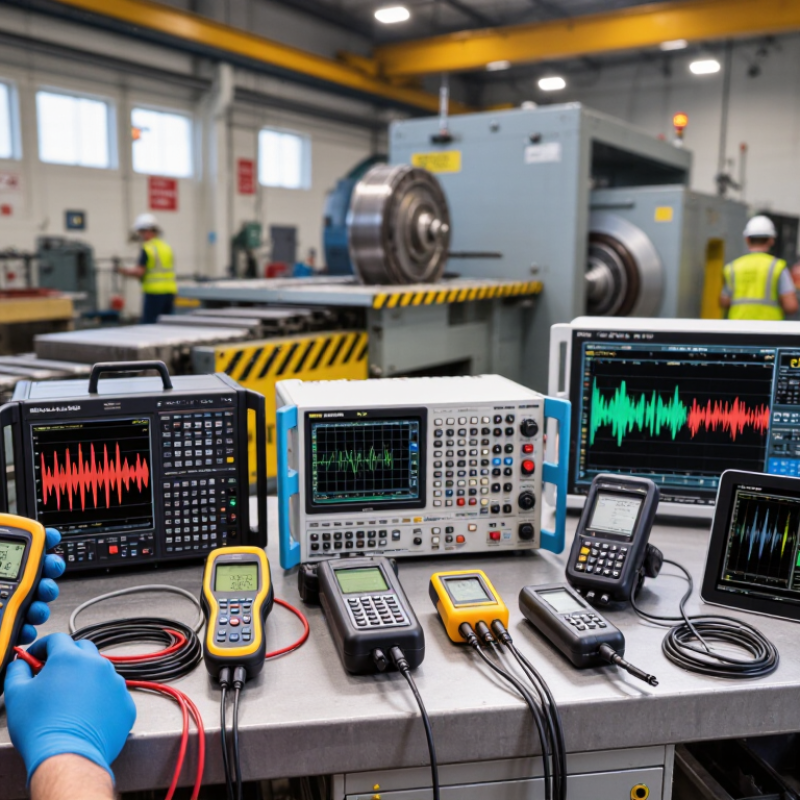
| 1 | Handheld vibration meter | Overall vibration level; some models also display acceleration and displacement | Velocity: mm/s RMS or in/s RMS; acceleration: m/s² or g; displacement: µm or mil | Generally intended for routine machine-condition checks; verify the instrument’s stated bandwidth | Quick checks on motors, pumps, fans, and other rotating machinery | Check which quantities and detector settings are supported, along with sensor compatibility and calibration requirements. |
| 2 | Portable vibration analyzer | Vibration spectrum and time waveform, usually with acceleration measurement | Acceleration: m/s² or g; velocity: mm/s or in/s; frequency: Hz or CPM | Model- and sensor-dependent; commonly used to examine machine vibration components across a selected bandwidth | Fault diagnosis, bearing and gear analysis, balancing, and troubleshooting | Review frequency range, number of channels, FFT resolution, recording options, and available analysis functions. |
| 3 | Route-based vibration data collector | Repeated readings at predefined machine measurement points | Typically acceleration, velocity, or displacement in their respective units | Depends on the connected sensor and the configured measurement settings | Scheduled condition-monitoring rounds across multiple machines | Consider route management, repeatable sensor positioning, data export, and compatibility with existing monitoring workflows. |
| 4 | Online vibration monitoring system | Continuous or scheduled vibration signals, alarm values, and trends | Acceleration: m/s² or g; velocity: mm/s or in/s; displacement: µm or mil | Determined by the sensors, acquisition hardware, sampling settings, and system configuration | Critical rotating equipment and installations requiring remote or continuous monitoring | Check channel count, alarm configuration, data storage, connectivity, environmental rating, and system integration. |
| 5 | IEPE piezoelectric accelerometer | Acceleration | m/s² or g; output is commonly specified in mV/g | Often suited to dynamic vibration measurements; the usable range varies with sensor design and mounting | Machine vibration, structural testing, and laboratory measurements | Requires compatible IEPE constant-current power. Check sensitivity, frequency response, mounting, temperature limits, and cable requirements. |
| 6 | MEMS accelerometer | Acceleration, often including static acceleration or tilt | m/s² or g | Ranges from low-frequency or DC-capable measurement to higher-frequency use, depending on the sensor | Embedded monitoring, portable instruments, low-frequency motion, and applications with space constraints | Compare noise density, bandwidth, measurement range, axis count, power needs, and sensitivity to temperature. |
| 7 | Seismic velocity transducer | Vibration velocity | mm/s or in/s; output may be specified in mV per unit of velocity | Typically selected for a defined frequency band; the sensor’s response limits should be checked | Machine vibration monitoring where a velocity-proportional sensor is appropriate | Confirm frequency response, orientation, mounting, output type, and whether the monitoring input matches the sensor. |
| 8 | Eddy-current proximity probe system | Relative shaft displacement and shaft position | µm or mil; output is commonly specified as voltage per displacement | Suitable for shaft-motion measurements within the probe and driver system’s specified bandwidth | Relative vibration and position measurement on accessible rotating shafts | Requires a compatible probe driver and a suitable conductive target. Check probe gap, target material, calibration, and installation geometry. |
| 9 | Laser Doppler vibrometer | Surface vibration velocity without physical contact | m/s, mm/s, or other velocity units; some systems also provide derived displacement or acceleration | Can cover a broad range, but the actual bandwidth depends on the optical system and measurement configuration | Non-contact testing of structures, small components, and difficult-to-access or delicate surfaces | Consider surface reflectivity, line of sight, stand-off distance, optical setup, and whether a reflective treatment is needed. |
| 10 | Geophone | Ground or structure motion, commonly velocity-proportional over its designed response band | Velocity: m/s or mm/s; output may be specified in V per unit of velocity | Selected for a particular low-frequency response; the natural frequency and usable band are model-dependent | Seismic surveys, ground-motion monitoring, and vibration measurements in civil or geotechnical work | Check natural frequency, damping, orientation, ground coupling, and the acquisition system’s input requirements. |



 © Copyright 2020 Tianjin Tanghaidongyang Valve Co., Ltd. All Rights Reserved.