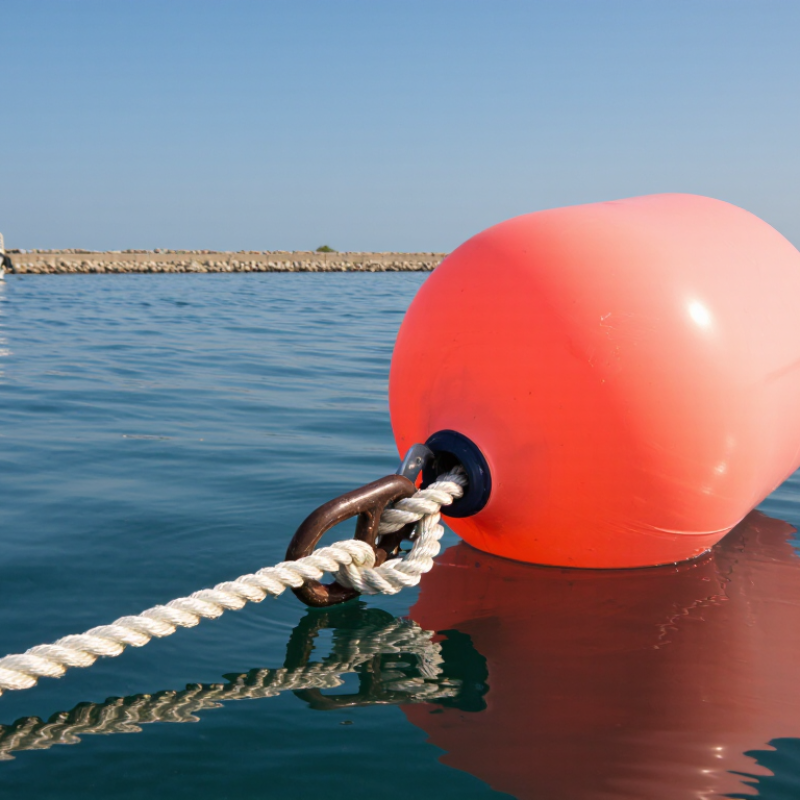
| Vessel mooring | Provides buoyancy at the water surface for a mooring connection, helping keep the pickup point accessible and supporting part of the mooring system. | A vessel connects a mooring line or hawser to buoy lifting or connection hardware; the buoy is connected to the seabed mooring system. | Vessel size, expected environmental loads, water depth, line geometry, connection design, and required reserve buoyancy. |
| Offshore equipment mooring | Supports buoyant components in a mooring arrangement for equipment such as floating work platforms or temporary offshore installations. | One or more buoys are incorporated into a designed system of lines, anchors, and surface connections. | Equipment weight and movement, current and wave conditions, anchor capacity, line loads, and the buoy’s certified structural rating. |
| Hawser or mooring-line support | Helps keep a connection point or section of line at the surface, making it easier for a vessel or work crew to locate and retrieve. | The buoy is attached to a specified line or retrieval arrangement using compatible, load-rated hardware. | Line weight, submerged line length, retrieval loads, attachment-point strength, visibility, and abrasion protection. |
| Temporary mooring and marine operations | Marks and supports a temporary mooring point during activities such as vessel servicing, construction, or offshore operations. | The buoy is deployed with the project’s engineered anchor and line arrangement and recovered when the operation is complete. | Deployment duration, changing sea conditions, site depth, inspection access, and safe recovery procedures. |
| Why use a foam-filled buoy? | A closed-cell foam core can help the buoy retain buoyancy if its outer skin is damaged, unlike a buoy that relies only on an air-filled cavity. | Common construction uses a tough outer elastomeric skin around a buoyant foam core; construction varies by design. | Check the specified buoyancy, outer-skin durability, resistance to impact and marine exposure, maintenance needs, and applicable test documentation. |
| Buoyancy and load planning | Provides buoyant force, but does not by itself anchor a vessel or establish the safe working load of the complete mooring system. | System design accounts for the buoy, connected lines, anchors, vessel or equipment, water depth, and environmental forces. | Net buoyancy depends on displaced seawater weight minus the buoy’s weight. Allow for submergence and suitable reserve buoyancy; verify structural and line loads separately. |



 © Copyright 2020 Tianjin Tanghaidongyang Valve Co., Ltd. All Rights Reserved.