| Definition | A shelf panel is a horizontal board installed between or against cabinet sides to support stored items. | It can be fixed, adjustable, pull-out, or removable depending on the cabinet design. |
| Role in the 32 mm Cabinet System | The panel is positioned within a cabinet construction based on a 32 mm modular drilling and component-spacing principle. | The 32 mm principle helps coordinate shelf positions, hinge locations, drawer components, and cabinet hardware. |
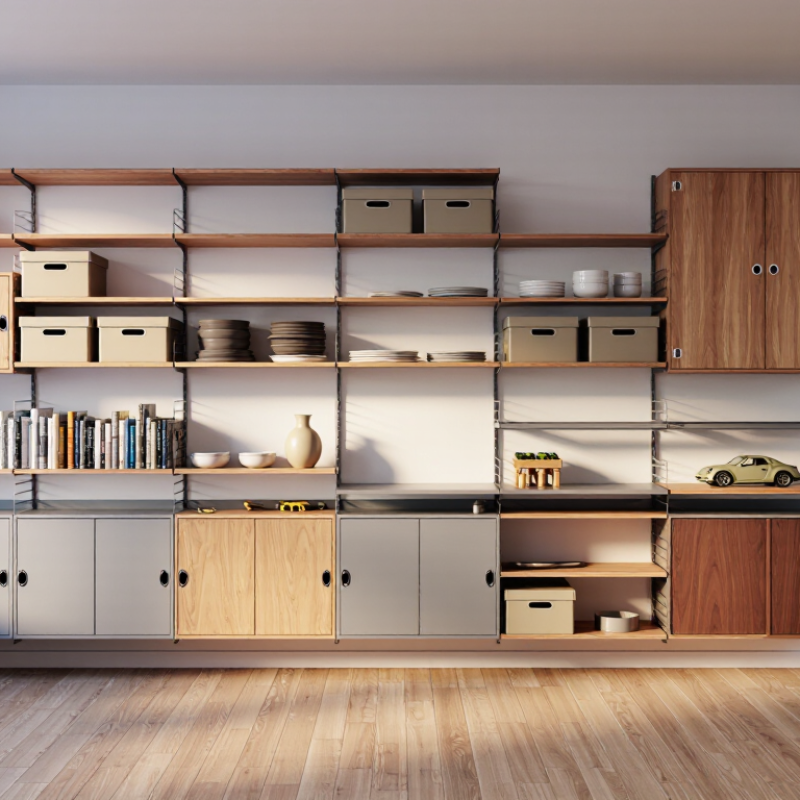
| Primary Function | To create a stable horizontal storage surface inside a cabinet, bookcase, wardrobe, pantry, or shelving unit. | The panel also divides a cabinet into usable vertical compartments. |
| Common Materials | Particleboard, medium-density fiberboard, plywood, solid wood, and laminated furniture board. | Material selection affects weight, moisture resistance, screw-holding strength, appearance, and load performance. |
| Typical Thickness | Common furniture-panel thicknesses include approximately 16 mm, 18 mm, and 19 mm. | The correct thickness must match the cabinet construction, shelf supports, edge treatment, and hardware clearances. |
| Width and Depth | Width is normally the clear distance between cabinet sides; depth is selected according to the cabinet body and intended storage. | Allow clearance for doors, drawers, hinges, drawer slides, and rear panels before finalizing dimensions. |
| Adjustability | Adjustable shelves are supported by shelf pins fitted into a vertical series of holes. | A common 32 mm system uses hole rows arranged on a 32 mm vertical pitch, although exact drilling specifications can vary. |
| Edge Treatment | Exposed edges may receive veneer, laminate edging, PVC edging, solid-wood lipping, or paint-grade finishing. | Edge treatment improves appearance and helps protect porous board materials from impact and moisture. |
| Installation Methods | Typical methods include shelf pins, support brackets, cleats, dowels, screws, cam fittings, or concealed hardware. | The fixing method should suit the panel material, expected load, span, and whether the shelf must be removable. |
| Load Capacity | Load capacity depends on material, thickness, shelf span, support spacing, fixing quality, and load distribution. | Heavy items should be placed near supports. Long unsupported spans may require a thicker panel, a center support, or a reinforcing edge. |
| Common Applications | Kitchen cabinets, wardrobes, office storage, bookcases, bathroom units, utility cabinets, and retail fixtures. | The panel can store dishes, books, clothing, files, containers, tools, and other household or commercial items. |
| Fixed vs. Adjustable | Fixed panels add rigidity to the cabinet, while adjustable panels allow the storage height to be changed. | A cabinet may combine both types to balance structural strength and storage flexibility. |
| Key Design Checks | Check the opening size, panel thickness, support positions, drilling pattern, edge finish, clearances, and expected load before installation. | Accurate measurement helps prevent sagging, interference with doors or drawers, and unstable shelf connections. |



 © Copyright 2020 Tianjin Tanghaidongyang Valve Co., Ltd. All Rights Reserved.