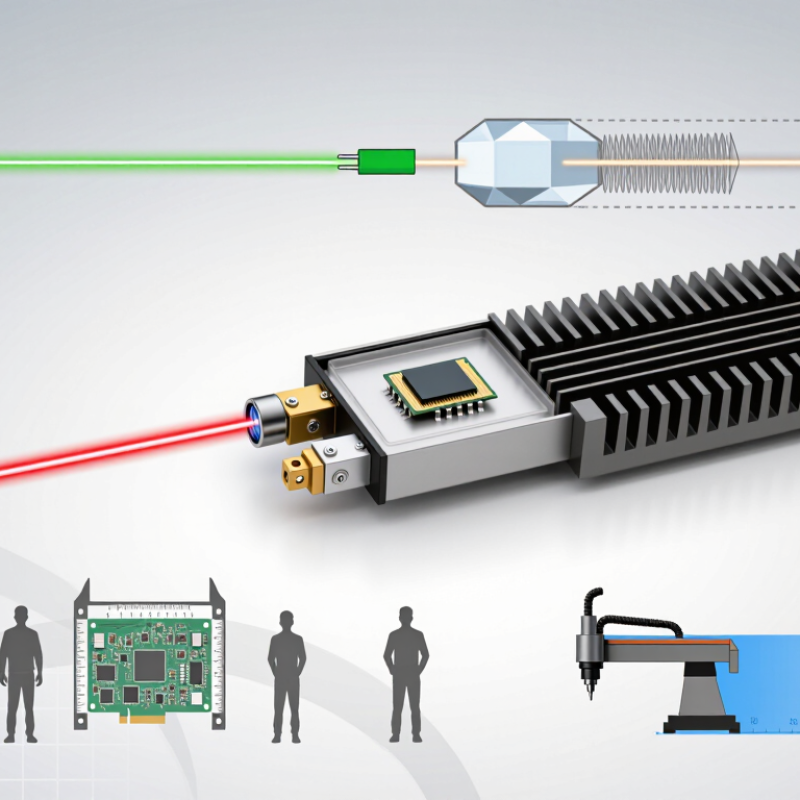
| Diode pump source | Semiconductor laser diode | Provides optical energy to excite ions in the solid-state gain medium. | Its wavelength is selected to overlap an absorption band of the gain medium. Around 808 nm is commonly used to pump Nd:YAG, though other pump wavelengths and materials are also used. |
| Gain medium | Neodymium-doped yttrium aluminum garnet (Nd:YAG) crystal | Amplifies light through stimulated emission after absorbing pump energy. | Nd:YAG commonly produces infrared laser light near 1064 nm. Other gain media can produce different wavelengths and operating characteristics. |
| Laser resonator | Optical cavity formed by two mirrors | Reflects light through the gain medium repeatedly, allowing amplification to build. | The cavity’s alignment and optical properties affect threshold, output, and beam characteristics. |
| High-reflector mirror | Mirror highly reflective at the laser wavelength | Returns most of the resonating light through the gain medium. | It is commonly designed to transmit the pump wavelength while reflecting the laser wavelength, depending on the laser configuration. |
| Output coupler | Partially transmitting cavity mirror | Allows a controlled portion of the circulating laser light to leave the cavity as the output beam. | Its reflectivity and transmission are chosen to balance output extraction with the gain available in the medium. |
| Pump-coupling optics | Lenses or reflective optics | Direct and focus pump light into the gain medium. | Efficient coupling helps reduce wasted pump energy and can improve output stability. |
| Thermal management | Heat sink, conductive mount, or cooling system | Removes heat generated in the diode and gain medium. | Temperature affects diode wavelength, gain-medium performance, and mechanical alignment; adequate cooling helps maintain stable operation. |
| Diode current driver | Regulated laser-diode power supply | Controls the electrical current supplied to the pump diode. | Low-noise, controlled current helps limit unwanted power fluctuations and protects the diode from excessive current. |
| Optional frequency-conversion crystal | Nonlinear crystal for second-harmonic generation | Converts the fundamental laser wavelength to a shorter wavelength. | For example, frequency-doubling 1064 nm output can produce light near 532 nm when the crystal and cavity are appropriately configured. |



 © Copyright 2020 Tianjin Tanghaidongyang Valve Co., Ltd. All Rights Reserved.