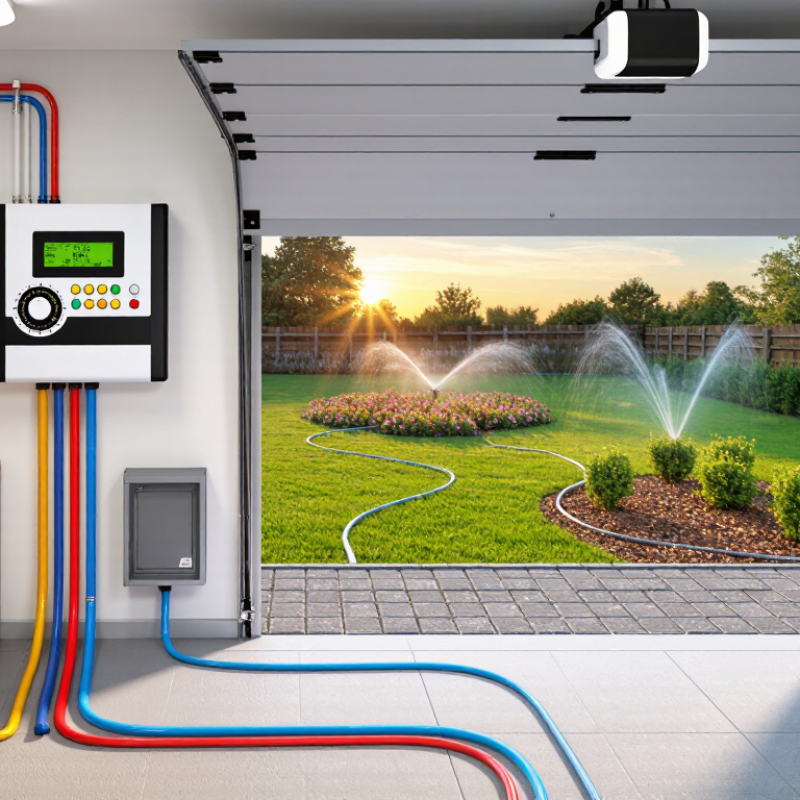
| Basic Definition | An electronic device that automatically controls when an irrigation system starts and stops. | It manages watering according to programmed schedules, reducing the need for manual valve operation. |
| Primary Function | Opens and closes irrigation valves at selected times and for selected durations. | This distributes water to designated landscape areas in a controlled and repeatable manner. |
| Control Method | Most controllers use a low-voltage electrical signal to operate irrigation zone valves. | The controller can operate several zones independently while using one central programming unit. |
| Irrigation Zone | A group of sprinklers controlled by the same valve. | Separate zones help accommodate differences in plant type, sun exposure, soil, slope, and sprinkler water output. |
| Common Scheduling Inputs | Start time, watering days, program frequency, and run time for each zone. | These settings determine when watering occurs and how long each zone operates. |
| Watering Start Time | The programmed time at which a watering cycle begins. | Scheduling irrigation during cooler, less windy periods can reduce evaporation and wind drift. |
| Zone Run Time | The length of time a selected irrigation zone remains active during a cycle. | Run time should be adjusted to soil infiltration, sprinkler precipitation rate, plant needs, and local conditions. |
| Watering Frequency | The number of days or intervals between irrigation cycles. | Frequency can be changed seasonally to reflect rainfall, temperature, plant growth, and soil moisture. |
| Manual Operation | A temporary function that starts a zone or complete cycle without changing the regular schedule. | It is useful for testing equipment, performing maintenance, or providing supplemental watering. |
| Rain Sensor Compatibility | A connection or wireless feature that allows a rain sensor to suspend scheduled watering. | When adequate rainfall is detected, irrigation can be paused to help prevent unnecessary water use. |
| Soil Moisture or Weather-Based Control | Advanced controllers may use soil-moisture readings or weather information to adjust irrigation. | Dynamic adjustments can better match watering with current landscape conditions than a fixed schedule alone. |
| Seasonal Adjustment | A setting that increases or decreases programmed run times by a percentage. | It allows the overall schedule to be adapted for seasonal changes without editing every zone individually. |
| Cycle-and-Soak Function | A feature that divides one long watering period into shorter cycles separated by rest periods. | It can reduce runoff and improve infiltration on compacted, clay, or sloped soil. |
| Typical Power Source | Household AC power is commonly converted to low-voltage output for irrigation valves; battery-powered units are also available for some applications. | A reliable power source keeps scheduled watering active and supports safe valve control. |
| Back-Up Protection | Some controllers include a backup battery or nonvolatile memory to preserve time and programming during a power interruption. | This helps prevent schedule loss and reduces the need for complete reprogramming after an outage. |
| Number of Zones | Controllers are available with different zone capacities, from small residential systems to larger multi-zone installations. | The required capacity depends on the number of independent valve groups in the irrigation system. |
| Water Conservation Role | The controller does not create water savings by itself; savings depend on correct programming, system maintenance, and appropriate sensors. | Accurate scheduling can help avoid overwatering, runoff, watering during rainfall, and irrigation at unsuitable times. |
| Maintenance Considerations | Schedules, sensors, wiring, valves, sprinkler heads, and seasonal settings should be checked periodically. | Regular inspection helps identify broken components, blocked nozzles, leaks, incorrect coverage, and programming errors. |
| Common Applications | Residential lawns, gardens, public landscapes, sports areas, commercial properties, and small agricultural installations. | The controller provides centralized automation wherever multiple irrigation zones require timed operation. |



 © Copyright 2020 Tianjin Tanghaidongyang Valve Co., Ltd. All Rights Reserved.