| 1. Material preparation | Pay-off stands and bobbins | Insulated conductors or other prepared elements are loaded onto the pay-off positions and routed toward the laying point. A central element may be fed separately when the cable design requires one. | Correct bobbin loading and material routing help prevent tangling, surface damage, and interruptions during production. |
| 2. Tension setting | Pay-off tension controls | Each element is supplied with controlled tension as it leaves its bobbin. The appropriate setting depends on the material, conductor size, and product construction. | Consistent tension helps keep the laid-up elements even and reduces slack, stretching, or unwanted deformation. |
| 3. Element guidance | Guides and pre-forming or closing dies | The individual elements are guided toward a common forming point and arranged in the required order around the cable axis. | Accurate guidance supports the specified core arrangement and helps maintain a uniform finished cable shape. |
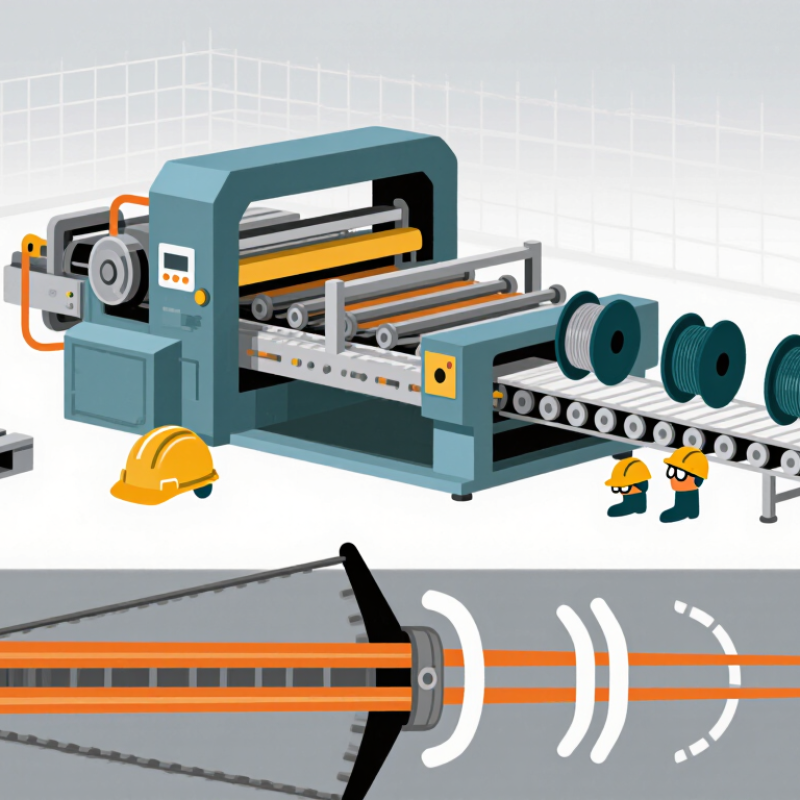
| 4. Bow rotation | Rotating bow assembly | The bow rotates around the machine axis while the elements move through the laying section. This rotation creates the relative movement that forms the lay. | The bow-based design provides a compact way to produce a regular lay. The suitable operating setup depends on the machine configuration and product requirements. |
| 5. Laying and closing | Laying point and closing die | The elements come together and are laid around one another, or around a central element, according to the cable design. | Lay direction, lay length, and element arrangement affect the cable’s geometry and handling characteristics. They are set for the product being manufactured. |
| 6. Optional taping | Taping unit, where fitted | Some machine configurations apply a wrapping tape over the laid-up core to hold the elements together or prepare the assembly for a subsequent process. | Taping is not present on every machine or required for every cable construction; the need depends on the product specification. |
| 7. Haul-off and take-up | Capstan or haul-off and take-up reel | The formed core is pulled through the machine and wound onto a take-up reel. Line speed and take-up operation are coordinated with the laying process. | Stable haul-off and winding help maintain consistent production and reduce the risk of loose or uneven winding. |
| 8. In-process inspection | Operator checks and production controls | Operators check the arrangement, surface condition, winding, and relevant product dimensions during production. Electrical or other product tests are performed as required by the product specification. | Regular checks help identify deviations early. Inspection criteria should be based on the cable design and applicable production requirements. |
| Why choose a bow type design? | Machine layout and rotating bow system | A bow type machine is one option for laying up multiple cable elements. Its suitability depends on the required product construction, production rate, element dimensions, and factory layout. | Before selection, confirm the allowable material and bobbin sizes, number of elements, required lay specifications, line speed, changeover needs, and available floor space with the machine supplier. |


 © Copyright 2020 Tianjin Tanghaidongyang Valve Co., Ltd. All Rights Reserved.