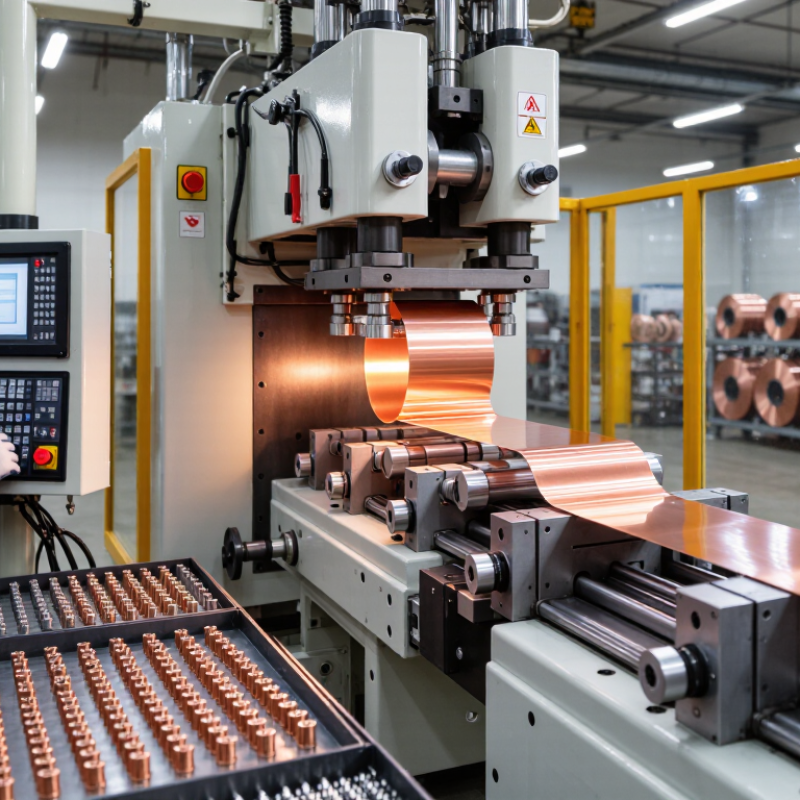
| Recommended Copper Applications | Electrical terminals, contact clips, busbar components, connector parts, shielding pieces, and spring contacts | Continuous coil-fed production using a progressive die | Copper’s high electrical conductivity makes it suitable for parts requiring efficient current transfer. |
| Typical Copper Strip Thickness | Approximately 0.10–2.00 mm, depending on alloy, part geometry, and press capacity | A high-speed terminal line commonly processes thin strip, often below 1.00 mm | Thinner strip and simpler geometries generally permit higher operating speeds. |
| Operating Speed Range | High-speed copper stamping: approximately 300–1,200 strokes per minute | 1,200 strokes per minute = 20 strokes per second | The maximum rate depends on die design, stroke length, material thickness, feed stability, and part complexity. |
| Stroke Length | Common high-speed applications use approximately 10–30 mm strokes | A short 20 mm stroke reduces unnecessary movement at high speed | Shorter strokes help reduce cycle time, vibration, and mechanical loading. |
| Theoretical Output per Hour | Output = strokes per minute × parts per stroke × 60 | 1,200 × 1 × 60 = 72,000 parts per hour | This is a theoretical figure before downtime, scrap, coil changes, inspection, and tooling adjustments. |
| Multi-Part Die Output | Progressive dies may produce two or more parts per stroke | 1,200 × 2 × 60 = 144,000 parts per hour for a two-up layout | Multi-up tooling increases output without increasing press speed, provided strip layout and die balance are suitable. |
| Practical Production Utilization | Approximately 70–85% of theoretical capacity in a stable production environment | 72,000 theoretical parts/hour × 80% = about 57,600 good parts/hour | Actual output reflects setup time, maintenance, material replenishment, inspection, stoppages, and scrap. |
| Press Capacity | High-speed applications commonly use compact presses from approximately 15–80 metric tons | The required tonnage must be calculated from shear length, material strength, thickness, and die configuration | Selecting excess capacity can reduce efficiency, while insufficient capacity may damage the press or tooling. |
| Feed Accuracy | Approximately ±0.02–0.05 mm in well-controlled high-speed applications | Accurate servo or mechanical feeding keeps each strip advance aligned with the die stations | Consistent feed accuracy improves dimensional repeatability and reduces die crashes. |
| Key Features for 1,200 SPM Operation | Rigid frame, balanced slide, low-inertia drive, precise feeder, lubrication, die monitoring, and vibration control | All systems must remain synchronized at 20 cycles per second | High-speed performance is achieved through coordinated press, feeder, tooling, lubrication, and quality-control systems. |
| Material Efficiency | Progressive strip layouts can achieve approximately 60–90% material utilization, depending on part shape and carrier design | An optimized layout reduces copper scrap while maintaining sufficient carrier strength | Because copper is a relatively high-value material, strip nesting and scrap recovery have a direct effect on production cost. |



 © Copyright 2020 Tianjin Tanghaidongyang Valve Co., Ltd. All Rights Reserved.