| Typical kerf width | Approximately 0.1–0.5 mm, depending on laser type and settings | Typically about 2–4 mm, depending on blade thickness | Commonly about 0.8–1.5 mm, depending on nozzle and abrasive use | Less material loss and better suitability for narrow strips, inlays, and intricate layouts |
| Contact with the tile | Non-contact thermal process | Mechanical contact between blade and tile | High-pressure water stream, usually with abrasive | Reduces tool wear, vibration, and the risk of mechanical chipping during cutting |
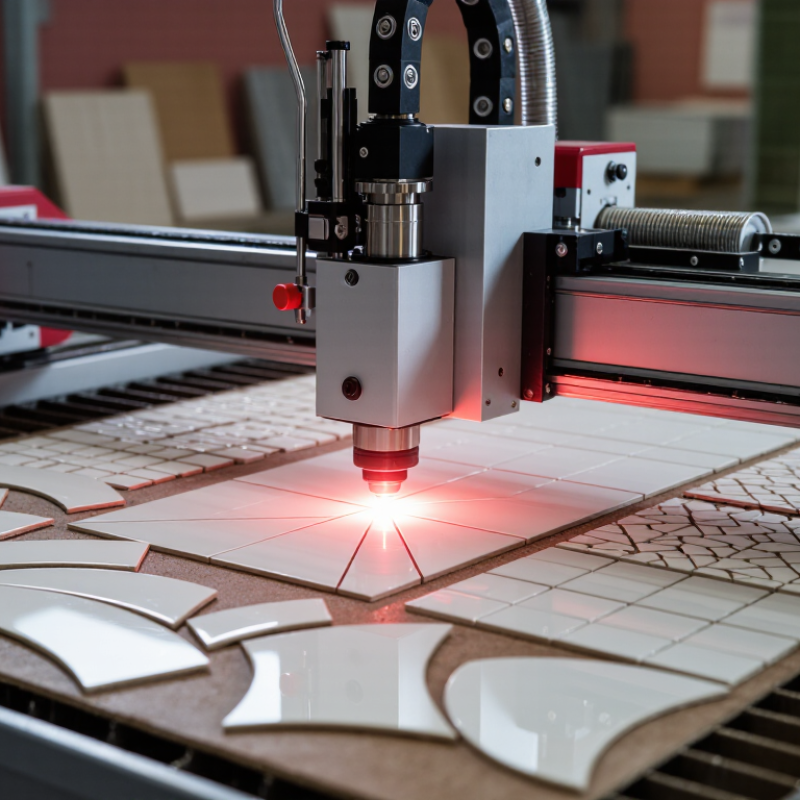
| Cutting geometry | Straight lines, curves, holes, slots, and programmed patterns | Mainly straight cuts and selected miter operations | Straight, curved, and complex two-dimensional profiles | Supports customized tile shapes without changing mechanical cutting tools |
| Typical setup or changeover | Software-based parameter and pattern change; no blade replacement for different shapes | May require fixture, guide, or blade adjustments | Usually requires nozzle, abrasive-flow, or fixture adjustments | Shorter changeover time for mixed orders and small production batches |
| Dry-process capability | Yes, with suitable fume extraction and process control | Dry cutting can generate respirable crystalline silica dust | Wet process; produces slurry and wastewater requiring management | Can reduce water consumption and eliminate slurry handling when the application is suitable |
| Consumable tooling | No cutting blade; optical components and filters still require scheduled maintenance | Diamond blades require dressing, adjustment, and eventual replacement | Abrasive, nozzles, or orifices require periodic replacement | Fewer shape-specific tools and more consistent production planning |
| Edge and surface quality | Clean, narrow cuts are possible; results depend on tile composition, glazing, focus, and speed | Reliable for many straight cuts, but mechanical chipping may occur | Good edge quality, although abrasive cutting may leave a textured edge | Improves the appearance of visible edges when the process is correctly calibrated |
| Automation potential | High; compatible with CAD/CAM files, nesting, vision alignment, and robotic loading | Moderate; automation is possible but often involves mechanical handling systems | High for programmed profiles, with additional water and abrasive-management systems | Supports repeatable production, digital scheduling, and reduced operator intervention |
| Best-fit production scenarios | Decorative patterns, custom orders, small batches, precision openings, and material-saving layouts | High-volume straight cutting and common rectangular formats | Thick materials, complex profiles, and applications requiring a cold cutting process | Enables manufacturers to expand customization while maintaining digital process control |



 © Copyright 2020 Tianjin Tanghaidongyang Valve Co., Ltd. All Rights Reserved.