| Test method | ASTM D4716/D4716M: in-plane flow rate per unit width and hydraulic transmissivity of a geosynthetic under a constant head. | Provides a standardized way to assess water flow within a drainage product’s plane while it is subjected to specified test conditions. |
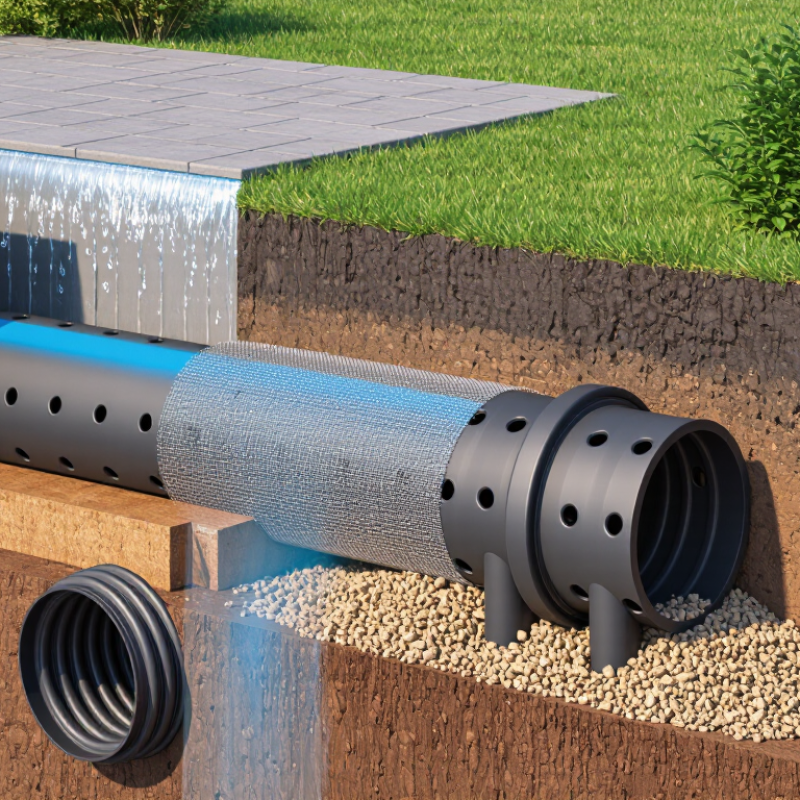
| In-plane flow | Water moving parallel to the plane of the geosynthetic, rather than through its thickness. | This is the drainage direction used by a blind drain to collect and convey water toward an outlet. |
| Normal compressive stress | Pressure applied perpendicular to the specimen during testing; the selected stress is a test condition, not a single universal value. | A useful evaluation checks flow under stresses representative of the project, because compression can reduce drainage channels. |
| Hydraulic gradient, i | The hydraulic head loss divided by the flow length; it is dimensionless. | Flow results should be compared at stated gradients, since the driving head affects measured flow. |
| Flow rate per unit width, q | q = Q/W, where Q is measured flow rate and W is specimen width. SI units: m²/s. | Normalizing by specimen width supports comparison between test specimens of different widths. |
| Hydraulic transmissivity, θ | θ = q/i for the reported test conditions. SI units: m²/s. | Expresses the in-plane flow capacity relative to the hydraulic gradient; it is condition-dependent and should be reported with the test conditions. |
| Unit conversion | 1 L/min per m of width = 1.667 × 10⁻⁵ m²/s. | Helps convert commonly used flow-per-width units to SI units for consistent reporting. |
| Calculation example | If Q = 0.60 L/min through a 0.30 m-wide specimen, then q = 2.0 L/min per m = 3.33 × 10⁻⁵ m²/s. At i = 0.10, θ = 3.33 × 10⁻⁴ m²/s. | Illustrates the calculations only. These values are not product test results or a performance claim. |
| Project comparison | Compare reported flow or transmissivity at matching normal stress, hydraulic gradient, and other stated test conditions. | A higher result under comparable conditions can indicate greater measured in-plane flow capacity, but it does not by itself establish long-term field performance. |



 © Copyright 2020 Tianjin Tanghaidongyang Valve Co., Ltd. All Rights Reserved.