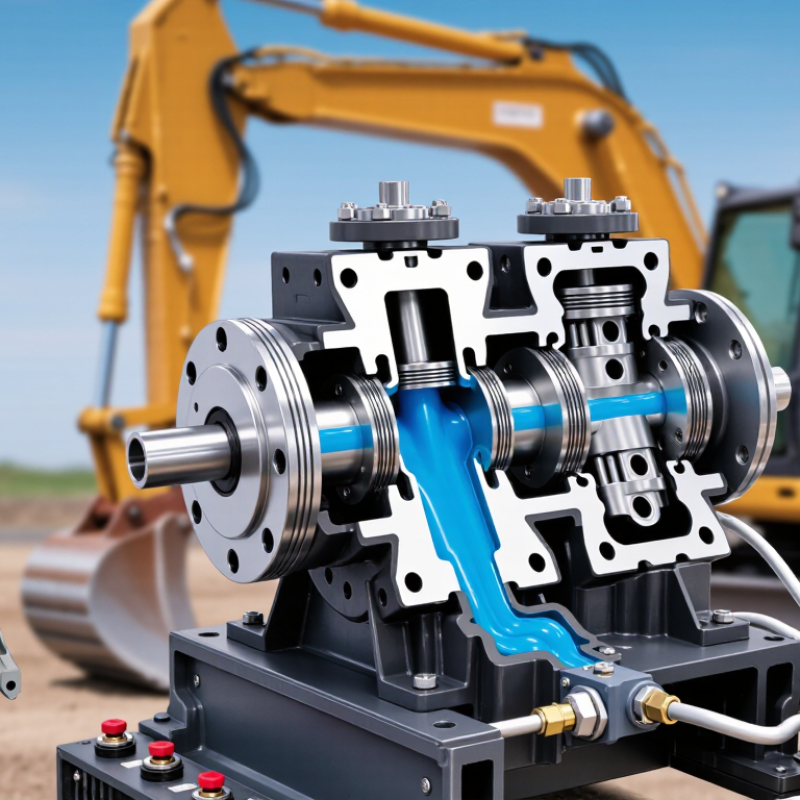
| Pumping principle | A rotating cylinder block contains pistons arranged parallel to its central shaft. As the block turns, the pistons move in and out of their bores, drawing fluid in and discharging it through separate ports. | Produces a steady flow from a compact rotary design. | Accurate port timing and clean hydraulic fluid help limit wear and internal leakage. |
| Swash-plate mechanism | In a swash-plate design, the angled plate causes the pistons to reciprocate as the cylinder block rotates. Changing the plate angle changes piston stroke and pump displacement. | Variable-displacement versions can adjust flow to match system demand. | Not all axial piston pumps are variable displacement; some have a fixed displacement. |
| Bent-axis mechanism | In a bent-axis design, the drive shaft and cylinder block are set at an angle. This geometry drives the pistons through their strokes as the assembly rotates. | Offers another established configuration for high-pressure hydraulic service. | Construction, size, speed limits, and performance depend on the specific design. |
| Flow and displacement | Theoretical flow is determined by displacement per revolution multiplied by rotational speed. Actual flow is lower because of volumetric losses. | Displacement and speed provide a practical way to estimate pump flow. | Actual output varies with pressure, fluid viscosity, temperature, wear, and pump efficiency. |
| Pressure capability | The pistons deliver fluid into a pressurized hydraulic circuit, while the pump’s structure and components withstand the resulting loads. | Axial piston pumps are commonly selected for demanding, high-pressure hydraulic systems. | Permitted continuous and peak pressures are model-specific; use the manufacturer’s ratings for the selected pump. |
| Flow control | A compensator or other control mechanism can change displacement in response to system conditions, depending on the pump design. | Can reduce unnecessary flow and help match output to changing actuator requirements. | Control response and available control options vary; correct adjustment and circuit design are important. |
| Efficiency and heat | Mechanical and volumetric losses convert some input power into heat. Losses generally increase when operating conditions move away from the pump’s intended range. | Efficient operation can reduce power demand and heat generation in a well-designed system. | Efficiency depends on pressure, speed, fluid, temperature, condition, and operating point. |
| Typical applications | Supplies hydraulic power in equipment such as mobile machinery, industrial hydraulic systems, and hydrostatic drives. | Useful where controlled hydraulic flow and high power density are important. | Selection should account for required flow, pressure, speed, duty cycle, fluid, and installation space. |
| Maintenance needs | Close-fitting pistons, bores, and port surfaces rely on suitable fluid and lubrication for reliable operation. | Good filtration and fluid care help maintain performance and service life. | Contamination, incorrect fluid, poor inlet conditions, and excessive temperature can accelerate damage. |



 © Copyright 2020 Tianjin Tanghaidongyang Valve Co., Ltd. All Rights Reserved.