| Loading and package preparation | Filled and sealed packages are loaded into baskets or carriers according to the validated loading pattern. | Consistent spacing and orientation help water circulate around packages and support repeatable heating. | Use the package type, load arrangement, and basket configuration specified for the scheduled process. |
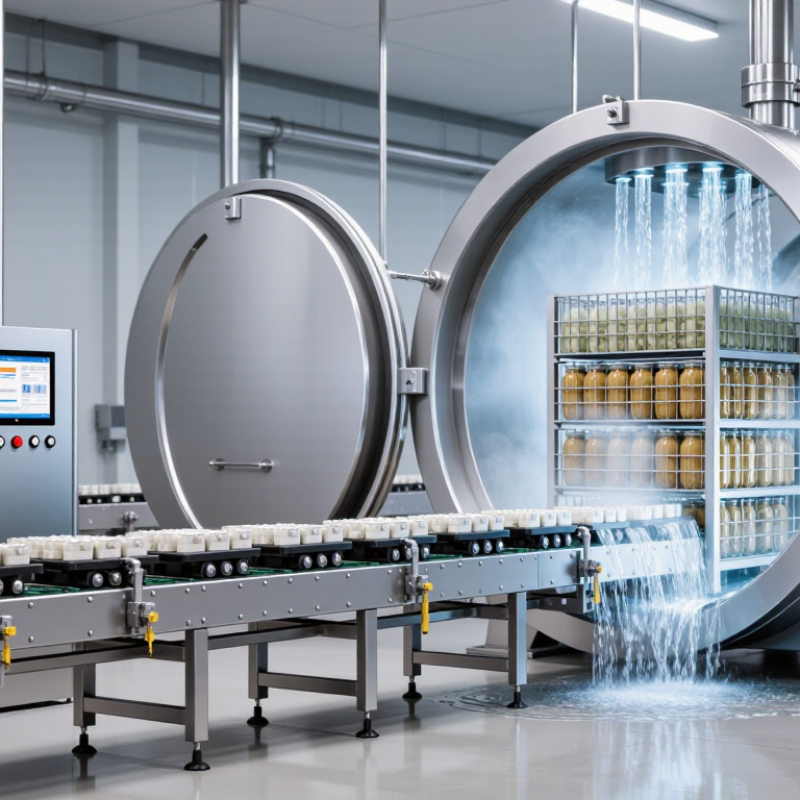
| Water circulation | A pump circulates process water, which is distributed over the load in a cascading or showering pattern. | Moving water transfers heat to package surfaces and helps reduce temperature differences within the retort load. | Circulation performance and water distribution must be established and maintained for the retort and load. |
| Come-up and heating | The circulating water is heated, commonly through a heat exchanger, until the process reaches its specified conditions. | Controlled heating brings the product toward the temperature required by its validated thermal process. | Heating time and temperature depend on the product, container, fill, and process design; there is no single universal schedule. |
| Temperature holding | The retort maintains the scheduled process conditions for the required time after the process temperature is reached. | The holding phase delivers the thermal treatment needed for the intended food-safety objective and product stability. | Follow the established scheduled process and applicable food-processing regulations; do not substitute a generic time or temperature. |
| Pressure and package protection | Retort pressure may be controlled, including with compressed air in applicable systems, to balance pressure changes during heating and cooling. | Appropriate pressure control can help protect flexible and semi-rigid packages from distortion or seal damage. | Pressure settings and control methods are equipment- and package-specific and must match the validated process. |
| Cooling | After the heat treatment, the load is cooled using circulating water; pressure may be maintained as needed during cooling. | Cooling limits continued cooking and helps protect packages while their contents and headspace change temperature. | Cooling-water quality, cooling conditions, and pressure control should be managed under the facility’s validated procedures. |
| Suitable package formats | Cascade retorts can be designed for specified containers such as cans, glass jars, and flexible or semi-rigid packages. | Water-based heat transfer can be applied to a range of package formats when the system and process are designed for them. | Compatibility depends on the retort design, package construction, closure, loading arrangement, and process validation. |
| Process monitoring and records | Operating instruments and records track relevant process conditions, such as temperature, pressure, and cycle timing. | Reliable records support process verification, traceability, and review of deviations. | Instrumentation, calibration, recordkeeping, and corrective actions should meet applicable regulations and facility procedures. |
| Potential operational benefits | Recirculated water provides a controlled heat-transfer medium, and automated controls can manage repeatable process steps. | These features can support consistent processing across properly configured loads and help accommodate multiple package formats. | Actual performance, energy use, throughput, and product quality depend on equipment design, operating conditions, and the validated process. |



 © Copyright 2020 Tianjin Tanghaidongyang Valve Co., Ltd. All Rights Reserved.