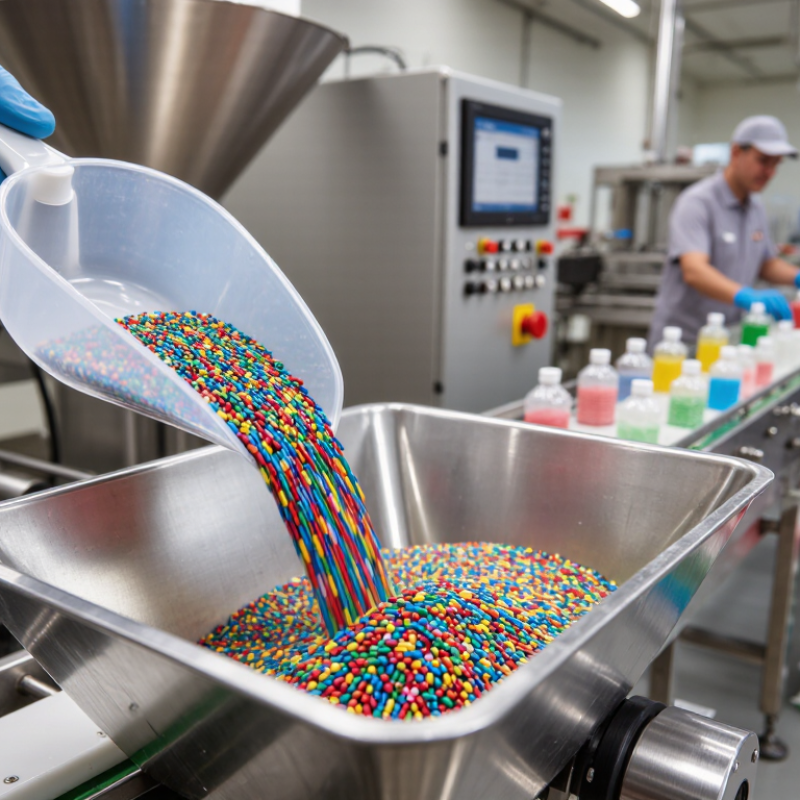
| Definition | A concentrated mixture of pigment or dye dispersed in a carrier resin, usually supplied as solid pellets. | The pellets are metered into the base polymer and melted during compounding, extrusion, injection molding, blow molding, or film production. | The carrier resin should be compatible with the production polymer to support uniform dispersion and minimize processing defects. |
| Typical Addition Rate | Commonly about 1% to 5% by weight for many color applications; some highly concentrated systems require less. | Controlled dosing allows the colorant concentration in the final part to be adjusted without handling loose pigment powder. | The required let-down ratio should be confirmed through laboratory trials and color matching rather than assumed from the product name alone. |
| Colorant Concentration | Commercial concentrates may contain a high level of pigment or dye, depending on pigment strength, carrier resin, and application requirements. | Shear and heat in the screw or melt-mixing zone distribute the concentrate throughout the polymer melt. | Higher concentration can reduce storage and handling volume, but excessive loading may affect viscosity, surface appearance, or mechanical properties. |
| Dispersion Quality | Provides pre-dispersed colorant, helping reduce agglomerates and visible specks when correctly formulated and processed. | The carrier resin softens and transports the pigment through the melt, while mixing elements break down remaining pigment clusters. | Poor dispersion may result from insufficient mixing, incompatible carriers, excessive throughput, moisture, or an unsuitable processing temperature. |
| Color Consistency | Supports repeatable shade control when pellet quality, dosage, resin grade, and processing conditions remain consistent. | A metering system feeds a defined quantity of masterbatch into a measured polymer stream. | Color quality should be checked using approved color standards and, where required, instrumental measurements such as CIELAB or ΔE. |
| Processing Temperature | Must be suitable for the temperature range of the host polymer and the thermal stability of the colorant. | The masterbatch melts or softens with the polymer during the selected processing cycle. | Excessive heat or residence time can cause pigment degradation, shade change, polymer discoloration, or volatile formation. |
| Moisture Management | Pelletized masterbatch is generally cleaner and easier to handle than loose powders, although some formulations can still absorb moisture. | Moisture may create bubbles, splay, silver streaks, hydrolytic degradation, or surface defects in moisture-sensitive polymers. | Store material in sealed packaging and follow the supplier’s drying guidance, especially for hygroscopic polymers such as polyamides and polyesters. |
| Feeding and Metering | Pellets can be dosed using gravimetric or volumetric feeders designed for the material’s flow characteristics. | The feeder regulates the masterbatch-to-polymer ratio before the materials enter the melting and mixing zones. | Stable pellet size, low dust, and consistent bulk density improve feeding accuracy and reduce housekeeping requirements. |
| Compatibility | Available in carrier systems selected for common polymers such as polyethylene, polypropylene, polystyrene, ABS, and engineering plastics. | Compatible polarities and melt-flow behavior help the colorant carrier blend into the host polymer rather than separate from it. | Incompatibility can cause streaks, plate-out, poor surface gloss, reduced weld-line strength, or uneven color. |
| Production Efficiency | Reduces the need to weigh and disperse raw pigment at every production run. | Pre-dispersed pellets shorten material preparation and can simplify color changes and batch control. | Purging procedures are still needed when changing between strong shades, sensitive polymers, or incompatible carrier systems. |
| Surface Appearance | Can deliver uniform color, gloss, opacity, translucency, or special visual effects when properly formulated. | Final appearance depends on pigment dispersion, mold or die conditions, cooling rate, polymer morphology, and surface replication. | Evaluate molded plaques or film samples under standardized lighting and viewing conditions. |
| Mechanical Properties | At an appropriate dosage, the effect on strength, impact resistance, and elongation is often limited but formulation-dependent. | Pigment particles and carrier resin become part of the polymer matrix and may influence crystallization, viscosity, or stress concentration. | For structural products, verify tensile strength, impact resistance, elongation, and dimensional stability after color addition. |
| Quality-Control Checks | Typical checks include shade, pigment dispersion, moisture, pellet appearance, bulk density, ash or pigment content, and thermal stability. | Testing confirms that the concentrate will perform consistently under the intended processing conditions. | Production approval should include a documented let-down ratio, processing window, reference sample, and acceptance criteria. |
| Compared with Loose Pigment | Usually offers cleaner handling, easier dosing, lower airborne dust, and more convenient integration into automated production. | The pigment is introduced as part of a resin-based concentrate rather than as a free-flowing powder. | Masterbatch may have a higher material cost per kilogram than raw pigment, but total handling and dispersion costs can be lower. |
| Compared with Liquid Colorant | Provides a solid, dry format that avoids liquid storage, pump calibration, and potential leakage. | Color is added through solid-pellet feeding and melt blending instead of liquid injection into the polymer stream. | Liquid systems may be suitable for certain processes, but the best option depends on equipment, polymer, dosage accuracy, and cleaning requirements. |
| Environmental and Safety Factors | Pelletized form can reduce pigment dust during normal handling and may simplify material containment. | During processing, the polymer and colorant are exposed to heat; decomposition products depend on the formulation and temperature. | Use the applicable safety data sheet, local regulations, ventilation, personal protective equipment, and appropriate waste-management procedures. |



 © Copyright 2020 Tianjin Tanghaidongyang Valve Co., Ltd. All Rights Reserved.