| Load classification | EN 124-1 and applicable product requirements | A15: 15 kN; B125: 125 kN; C250: 250 kN; D400: 400 kN; E600: 600 kN; F900: 900 kN test load | Select the class according to the actual traffic and pedestrian environment, not only by grate material. |
| Typical location by EN 124 class | EN 124 application zones | A15: pedestrian and cycle areas; B125: footways and car parks; C250: kerbside channels; D400: carriageways and hard shoulders; E600/F900: higher-load industrial or aircraft areas | The specified class should match the installation zone and the local authority's road hierarchy. |
| Material specification | ASTM A240/A240M | Covers chromium and chromium-nickel stainless steel plate, sheet, and strip for pressure-vessel and general applications; it does not by itself certify grate load capacity. | Use ASTM A240/A240M to define the stainless steel material, then verify structural performance under the required grate standard. |
| Common stainless steel grade: Type 304 | ASTM A240 Type 304 / EN 10088-2 equivalent family | Typical ASTM chemical limits include chromium 18.0–20.0% and nickel 8.0–10.5%; exact limits depend on the applicable edition and product specification. | Suitable for many urban, indoor, and moderately corrosive drainage environments when fabrication and maintenance are properly controlled. |
| Common stainless steel grade: Type 316/316L | ASTM A240 Type 316/316L / EN 10088-2 equivalent family | Typical ASTM limits include chromium 16.0–18.0%, nickel 10.0–14.0%, and molybdenum 2.0–3.0%; Type 316L has a maximum carbon limit of 0.030%. | The molybdenum-bearing grade generally provides better resistance than Type 304 in chloride-bearing or marine-influenced drainage locations. |
| Corrosion environment | Project environmental assessment and local material rules | Consider chlorides, coastal exposure, de-icing salts, wastewater chemistry, cleaning chemicals, humidity, and crevice conditions. | Stainless steel reduces coating-maintenance requirements, but grade selection and fabrication quality remain essential. |
| Welded fabrication | Applicable welding procedure, inspection, and local structural requirements | Weld heat tint and iron contamination can reduce corrosion resistance; post-weld cleaning, pickling, passivation, or an approved equivalent treatment may be required. | Specify fabrication controls and inspection records instead of relying solely on the stainless steel grade designation. |
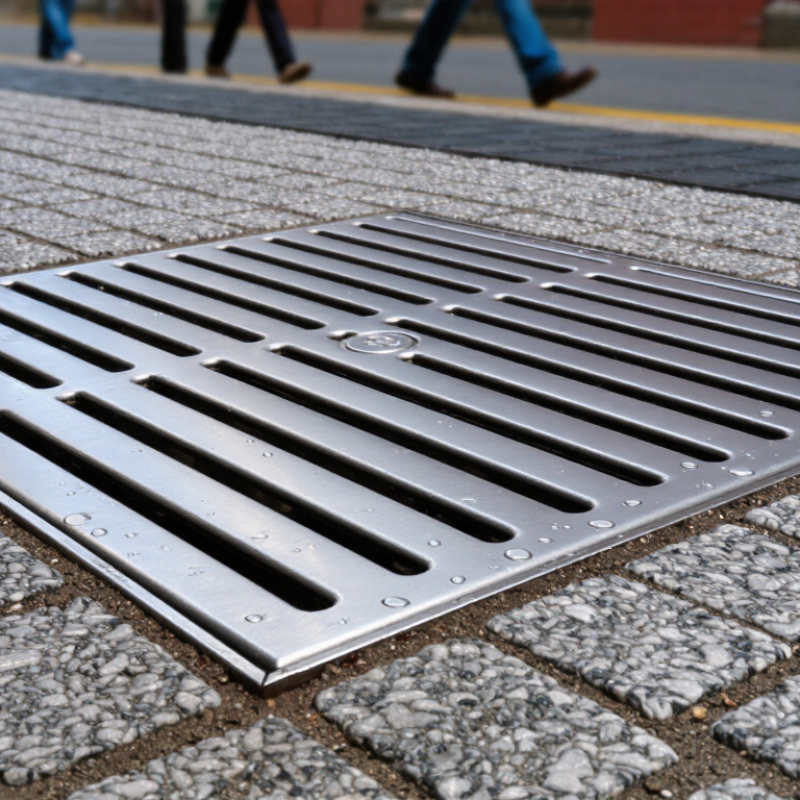
| Slip resistance | Local accessibility, pedestrian-safety, and workplace-safety regulations | A smooth polished surface is not automatically slip resistant, especially when wet; the required wet-slip test method depends on the jurisdiction. | Use a textured, serrated, or otherwise tested walking surface where the grate is located in pedestrian traffic areas. |
| Hydraulic opening area | Drainage authority requirements and project hydraulic calculations | There is no single universal open-area percentage for all sewer grates; required flow capacity depends on rainfall intensity, catchment area, slope, inlet geometry, and blockage allowance. | Document clear opening area, bar spacing, head loss, and debris-blockage assumptions for each project. |
| Bar and slot safety | Local accessibility and pedestrian-safety codes | Requirements for slot width, orientation, heel and wheelchair safety, and small-object retention vary by jurisdiction and installation type. | Confirm local dimensional limits before finalizing slot geometry; do not use a generic opening size for every market. |
| Dimensional tolerances and fit | EN 124 product requirements, project drawings, and local infrastructure specifications | Frame dimensions, seating, level adjustment, bearing surfaces, and anti-rocking details must be controlled within the approved design tolerances. | Accurate fit helps prevent noise, impact damage, ponding, and premature fatigue at the frame-to-grate interface. |
| Testing and documentation | Specified EN 124 test route, ASTM material certification, and local inspection requirements | Typical records include material certificates, heat or batch traceability, dimensional inspection, weld inspection, surface-treatment records, and load-test results. | A compliance dossier allows authorities and project consultants to verify both material identity and finished-product performance. |
| Local code coordination | National, state, municipal, road-authority, and utility-owner requirements | Local codes may add requirements for load class, dimensions, accessibility, corrosion protection, markings, installation, inspection, and maintenance. | Use EN 124 and ASTM A240 as design references only after confirming the mandatory code hierarchy for the target country. |
| Recommended specification format | Project technical specification and approved drawings | State grade, product form, nominal thickness, grate and frame dimensions, load class, open area, slip resistance, finish, weld treatment, fixings, and test documentation. | A complete specification prevents the material standard from being mistaken for a complete performance or regulatory approval. |



 © Copyright 2020 Tianjin Tanghaidongyang Valve Co., Ltd. All Rights Reserved.