| Hand Pallet Truck | Moving palletized loads over short distances | Approximately 2,000–5,500 lb (900–2,500 kg) | Warehouses, loading areas, and retail backrooms with level floors | Load weight, pallet dimensions, aisle width, floor condition, and travel distance | Low purchase and maintenance cost with simple manual operation |
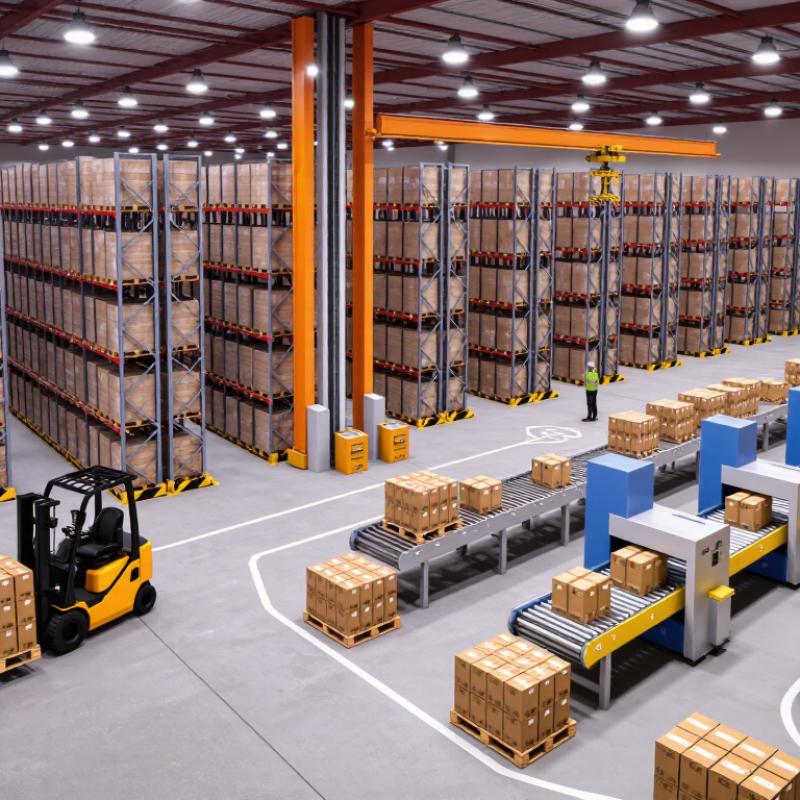
| Forklift Truck | Lifting, stacking, and transporting palletized materials | Common warehouse capacities range from about 3,000–10,000 lb (1,360–4,540 kg) | Warehouses, factories, yards, and distribution centers; model-dependent | Rated capacity at lift height, load center, mast height, turning radius, fuel or battery type, and operator training | High lifting capacity and efficient horizontal movement |
| Reach Truck | Placing and retrieving loads in high warehouse racks | Often approximately 2,000–4,500 lb (900–2,040 kg), depending on lift height and configuration | Indoor distribution centers with narrow aisles and high-density storage | Required lift height, aisle width, rack layout, residual capacity, and floor flatness | Improves vertical storage utilization in narrow aisles |
| Electric Pallet Jack | Frequent pallet movement across short and medium distances | Commonly approximately 4,000–8,000 lb (1,800–3,630 kg) | Indoor facilities where low noise and zero direct exhaust emissions are important | Duty cycle, battery capacity, charging facilities, aisle width, ramp gradients, and operator controls | Reduces physical effort and supports higher throughput than manual handling |
| Conveyor System | Continuous movement of cartons, totes, parcels, or components | Determined by product size, weight, belt or roller design, and line speed | Fixed production lines, sortation areas, packing stations, and distribution centers | Throughput, product dimensions, accumulation requirements, layout, noise, guarding, and controls integration | Predictable material flow and reduced manual carrying |
| Automated Guided Vehicle (AGV) | Repeated transport between defined pickup and drop-off points | Capacity varies widely; many systems are designed for several hundred kilograms to several tonnes | Structured facilities with stable routes, controlled traffic, and repeatable workflows | Payload, navigation method, route complexity, traffic management, battery charging, safety controls, and system integration | Consistent transport performance and reduced dependence on repetitive manual travel |
| Overhead Crane | Lifting and positioning heavy or oversized loads | Capacity is application-specific and may range from a few tonnes to substantially higher ratings | Manufacturing plants, fabrication areas, maintenance bays, and heavy industrial spaces | Rated load, span, lift height, duty class, building structure, load path, controls, and inspection requirements | Uses overhead space while keeping floor areas available for other operations |
| Scissor Lift Table | Raising loads or workers to a more ergonomic working height | Capacity depends on platform size, lift height, and whether it is designed for goods or personnel | Assembly, packing, maintenance, loading, and order-picking operations | Platform dimensions, load type, lift range, mobility, guarding, stability, and applicable safety requirements | Improves ergonomics and can reduce bending, reaching, and manual lifting |



 © Copyright 2020 Tianjin Tanghaidongyang Valve Co., Ltd. All Rights Reserved.