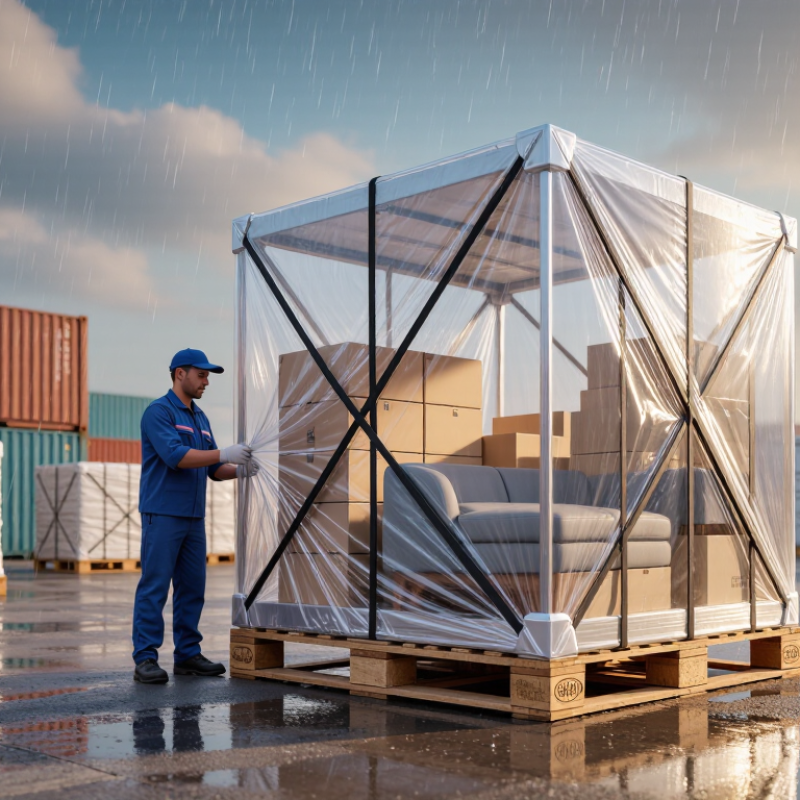
| Rain, Snow, and Spray | Open-yard storage, port handling, truck transport, and sea-spray exposure. | Creates a temporary barrier that reduces direct wetting of machinery, crates, pallets, and packaged components. | Water exposure may occur repeatedly during loading and unloading; protection should be maintained whenever the cargo is outdoors. | Water-resistant fabric, covered seams, overlapping openings, securely closed edges, and reinforced tie-down points. | Water-repellency screening may use AATCC 22; full cover performance should be validated on the finished design. |
| Humidity and Condensation | High humidity, temperature cycling, and condensation inside containers or enclosed storage areas. | Limits moisture contact while a breathable construction can reduce trapped vapor and condensation risk. | Cyclic damp-heat testing commonly uses up to 95% relative humidity, depending on the selected test severity. | Use breathable panels where appropriate, avoid sealing wet cargo, and combine covers with desiccants or vapor barriers when required. | IEC 60068-2-30 addresses cyclic damp heat; ISO 2233 provides conditioning guidance for packaged products. |
| Salt Air and Corrosive Atmospheres | Marine terminals, coastal warehouses, and extended ocean transport. | Reduces deposition of salt particles and salt-laden moisture on exposed metal surfaces. | Corrosion protection should be assessed together with surface coatings, VCI materials, desiccants, and packing seals. | Low-permeability fabric, closed seams, minimal gaps, corrosion-prevention treatment, and sufficient internal air volume. | IEC 60068-2-11 or ASTM B117 may support salt-atmosphere evaluation; results are not direct predictions of field life. |
| Ultraviolet Exposure | Temporary outdoor storage, transshipment delays, and uncovered staging areas. | Shields cargo and helps slow fabric fading, embrittlement, and degradation caused by sunlight. | UV durability depends on fabric type, pigment, stabilizers, climate, and exposure duration; no universal service life applies. | UV-stabilized polymer, opaque construction, reinforced stitching, and a defined inspection or replacement interval. | ASTM G154 can be used for accelerated laboratory exposure of nonmetallic materials. |
| Dust, Sand, and Particles | Desert routes, construction sites, dry ports, and dusty warehouse environments. | Reduces airborne particle deposits on filters, electrical components, polished surfaces, and moving parts. | Particle protection is strongly affected by opening size, closure design, and pressure differences around the cargo. | Close-fitting panels, sealed or overlapping openings, covered zippers, and cleanable outer surfaces. | IEC 60529 provides enclosure ingress classifications; a packing cover should not be assigned an IP rating without testing. |
| Abrasion and Handling Damage | Forklift movement, crane lifting, stacking, pallet contact, vibration, and repeated loading operations. | Provides a sacrificial outer layer that helps prevent scuffs, scratches, and minor surface contamination. | Cover protection cannot replace correct blocking, bracing, cushioning, or load restraint inside the shipping unit. | Heavy-duty fabric, corner patches, double stitching, smooth internal surfaces, and no loose straps near lifting equipment. | ASTM D4169 and ISTA distribution procedures can support package-level handling and transport evaluation. |
| Wind and Cover Uplift | Open decks, port yards, truck beds, and temporary outdoor storage during storms or strong winds. | Keeps the protective layer positioned over the cargo and reduces exposure caused by flapping or displacement. | Wind performance depends on cover area, geometry, anchoring pattern, local wind speed, and surrounding obstructions. | Elastic hems, webbing straps, multiple anchor points, low-profile shaping, and installation instructions. | Wind-load calculations should follow the destination’s applicable building or transport requirements. |
| Temperature Extremes | Cold-weather routes, hot container interiors, direct sunlight, and rapid temperature transitions. | Reduces direct solar heating and limits exposure to rapid surface temperature changes. | The required temperature range must be established from the cargo specification and route risk assessment. | Flexible low-temperature material, heat-resistant fabric, color stability, and allowance for thermal expansion. | IEC 60068 environmental testing methods can be selected for high- and low-temperature evaluation. |
| Long-Term Storage | Idle inventory, project cargo waiting for installation, and repeated warehouse transfers. | Maintains a clean separation between the cargo and the surrounding storage environment. | Covers should be inspected periodically for water pooling, tears, mildew, loose fasteners, and trapped condensation. | Breathable construction where needed, elevated cargo placement, drainage clearance, inspection access, and repairable panels. | Storage conditions should be documented using temperature, humidity, cleanliness, and inspection records. |



 © Copyright 2020 Tianjin Tanghaidongyang Valve Co., Ltd. All Rights Reserved.