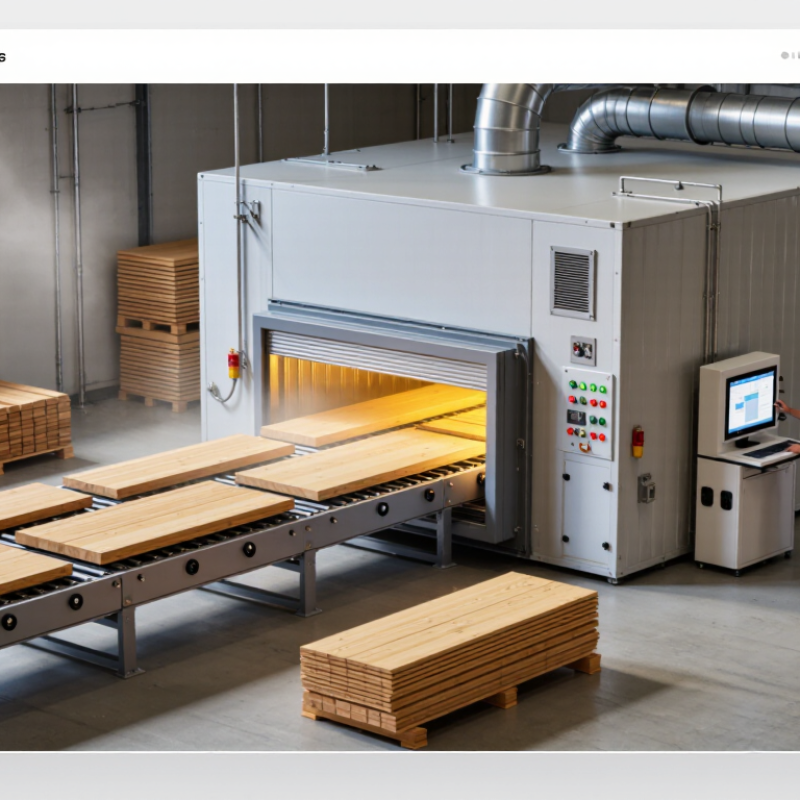
| Conventional kiln | Circulates heated air through stacked lumber. Heat encourages moisture to move from the wood’s interior to its surface, while ventilation carries water vapor out of the kiln. | Commercially drying sawn lumber for furniture, flooring, construction, and woodworking. | Often about 6–12% for indoor uses; targets vary by product and local conditions. | Temperature, relative humidity, airflow, and drying time are adjusted to limit checking, warping, and other defects. |
| Dehumidification kiln | Uses a heat-pump system to cool humid air and condense water from it. The recovered heat warms the circulating air, which continues drying the lumber. | Small and medium-scale operations, specialty lumber, and lower-temperature drying schedules. | Commonly about 6–12% for many interior applications. | Moisture removal depends on air circulation, load arrangement, and the kiln’s ability to manage condensate and humidity. |
| Solar kiln | Uses solar energy to warm air inside an enclosure. Vents release moisture-laden air, and fans may help circulate air through the lumber stack. | Small-scale drying where lower equipment complexity and use of solar heat are priorities. | Can reach roughly 10–20%, depending on climate, design, season, and schedule. | Drying is weather-dependent; airflow and venting help prevent excessive humidity and uneven drying. |
| Vacuum kiln | Reduces pressure around the lumber, allowing moisture to evaporate at a lower temperature. Heat is supplied to the wood, often through plates or circulating media. | Thick, valuable, or difficult-to-dry lumber where shorter drying times or lower drying temperatures may be useful. | Set according to the intended end use; targets commonly fall within the range used for other kiln-dried lumber. | Requires a sealed chamber and controlled pressure, heat, and drying cycles; performance depends on wood species and dimensions. |
| Air-drying yard and fans | Natural or fan-assisted airflow carries water vapor away from board surfaces as moisture gradually migrates out of the wood. | Pre-drying lumber before kiln drying, or drying stock where longer drying times are acceptable. | Often approaches approximately 15–25%, depending on climate and exposure; it may not reach indoor-use targets. | Stack spacing, stickers, rain protection, ground clearance, and airflow influence uniformity and drying time. |
| Moisture monitoring equipment | Pin-type meters measure electrical resistance between pins; pinless meters estimate moisture using electromagnetic readings. These devices monitor drying progress rather than remove moisture directly. | Checking lumber during drying and verifying whether it is near its target moisture content. | Readings are compared with the project’s specified target, with adjustments for species and temperature where applicable. | Meter readings are estimates and can be affected by species, temperature, grain direction, and measurement depth. |
| Moisture-content targets and drying times vary with wood species, board thickness, starting moisture content, end use, and local conditions. Moisture content is commonly expressed as a percentage of the oven-dry weight of the wood. |



 © Copyright 2020 Tianjin Tanghaidongyang Valve Co., Ltd. All Rights Reserved.